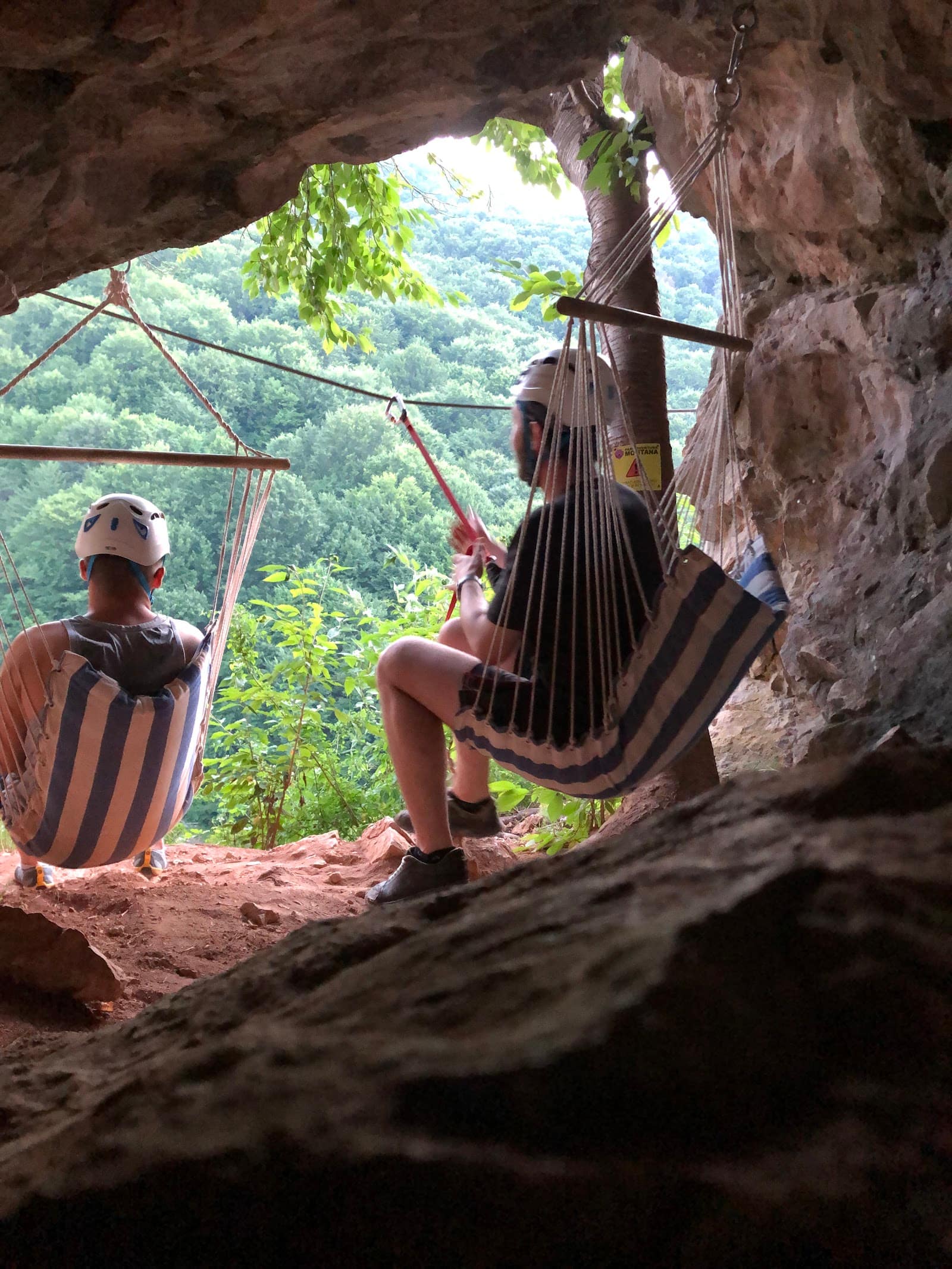
Via ferrata routes in Romania have exploded in popularity in recent years, turning rock walls once reserved for mountaineers into routes accessible to anyone with the right gear and a minimum of training. Via ferrata — "iron road" in Italian — means a route equipped with steel cables, rungs, ladders and bridges, along which you progress secured by a special kit. This guide reviews the best-known routes, the mandatory equipment and the safety rules.
Important from the start: via ferrata is not hiking. It is an activity with real exposure, where a securing mistake can be fatal. The equipment is not optional, and for beginners a guide is the best investment.
Well-known via ferrata routes
Here are some of the most popular routes. The difficulty ranges from beginner routes to lines that demand strength and experience.
- Astragalus — Turda Gorge (Apuseni). One of the best-known via ferratas in the country, on the spectacular walls of the Turda Gorge, in the Apuseni. It has difficulty variants, which makes it suitable for supervised beginners too.
- The 7 Ladders area (Piatra Mare Mountains, near Brașov). Near the famous 7 Ladders canyon, via ferrata routes have been set up, in a setting of forest and waterfalls.
- Vidraru (Făgăraș). Equipped routes around the Vidraru dam, on the Argeș valley, easily reached from the Făgăraș-Transfăgărășan area.
- Other areas. New routes appear constantly in various massifs; check the condition and grade of each one on the spot or at local centres, since the equipping is sometimes modified.
To explore all such sights, use the via ferrata filter in the attractions section.
Mandatory equipment
Do not venture onto a via ferrata without the full kit. The absolute minimum:
- Climbing harness — well adjusted on the body.
- Via ferrata set (lanyard with energy absorber) — specifically designed for via ferrata, with a shock-absorbing system. Do not improvise with ordinary slings.
- Helmet — protects from falling rocks and knocks.
- Gloves — the steel cable cuts and wears the hands.
- Mountain boots or shoes with good grip.
The via ferrata set with an energy absorber is the critical element: in a fall, it dissipates the shock force. An improvised lanyard can generate forces that break the harness or cause serious injury. Check the date and condition of the equipment before every outing.
Safety rules
A few non-negotiable principles:
- Always one carabiner clipped. When you pass an anchor point, move the carabiners one at a time, never both at once. That way you are secured at all times.
- Distance between team members. Only one person per cable section, so the shock is not transmitted in a chain during a fall.
- Check the weather. On wet rock or in an electrical storm, the steel cable becomes dangerous. Consult the mountain forecast and turn back if the weather breaks.
- Do not overestimate yourself. Start with easy routes. Arm strength runs out fast on hard lines.
For a full picture of the risks, read our guide to safety and weather in the mountains, which covers storms, hypothermia and retreat decisions.
With a guide or on your own
If it is your first via ferrata, go with a guide or an experienced person. A guide checks your equipment, teaches you the securing manoeuvres and picks a route that suits you. Adventure centres in the popular areas offer rental gear and guided trips.
You can go on your own once you have mastered the manoeuvres and have your own certified equipment — and never alone on exposed routes.
Who it suits
- Beginners: beginner routes such as the easy Astragalus variants, with a guide.
- Intermediate: longer routes, with vertical sections.
- Advanced: athletic routes, with overhangs, demanding strength and technique.
If you want classic hikes between via ferrata outings, see the top hiking trails in Romania selection and the sights in the attractions section.
Frequently asked questions
What is a via ferrata?
A mountain route equipped with steel cables, rungs, ladders and bridges, along which you progress secured by a special kit. It allows you to cross rock walls without advanced climbing techniques, but with real exposure.
What equipment do I need?
A climbing harness, a via ferrata set with an energy absorber, a helmet, gloves and footwear with good grip. The set with a shock absorber is mandatory and must not be improvised.
Is via ferrata dangerous?
It has real exposure, and a securing mistake can be fatal. With the right gear, good technique and suitable weather, the risk is manageable. Check the weather and read the safety guide.
Can I go as a beginner?
Yes, on beginner routes and preferably with a guide who checks your equipment and teaches you the manoeuvres. Start with easy routes such as the Astragalus variants.
Where do I find via ferrata routes in Romania?
See the dedicated filter in the attractions section. Among the best known are Astragalus in the Turda Gorge, the 7 Ladders area near Brașov and the Vidraru routes.